A digital transformation agency for a small or mid-sized company should hand you working software within weeks, not a strategy deck to approve. Kaishift maps where your team's hours actually go, fixes one process end to end, measures it, then moves to the next. AI goes only where a step needs judgment on messy input, and everything runs on accounts your company owns. Before any commitment, within 72 hours of a 30-minute call, you get a written proposal and a free demo running on one of your real tasks.
Most SMEs are not short of software. They have a CRM nobody updates, a booking tool that does not talk to the accounting tool, and a WhatsApp inbox where half the business actually happens. At that size, transformation means closing those gaps one at a time, until the company runs on its systems instead of on someone's memory.
Digital transformation for an SME is the work of moving a company's recurring processes out of inboxes, spreadsheets and people's heads into software that runs them, records them and lets you measure them. In a small or mid-sized company it happens process by process, not as one programme, and it is judged by hours returned and errors avoided.
Digital transformation
what it does for you
One process at a time
A real fix in weeks, measured in hours returned and errors avoided, before the next one starts.
AI only where it earns it
Fixed steps become simple automations. A model is used only where a message needs to be understood.
Your team keeps it
Everything runs on your accounts and is written down, so the company runs on systems, not on memory.
Your case is different?
Tell us in 30 minutes. Within 72 hours you get a written proposal and a free demo on your case.
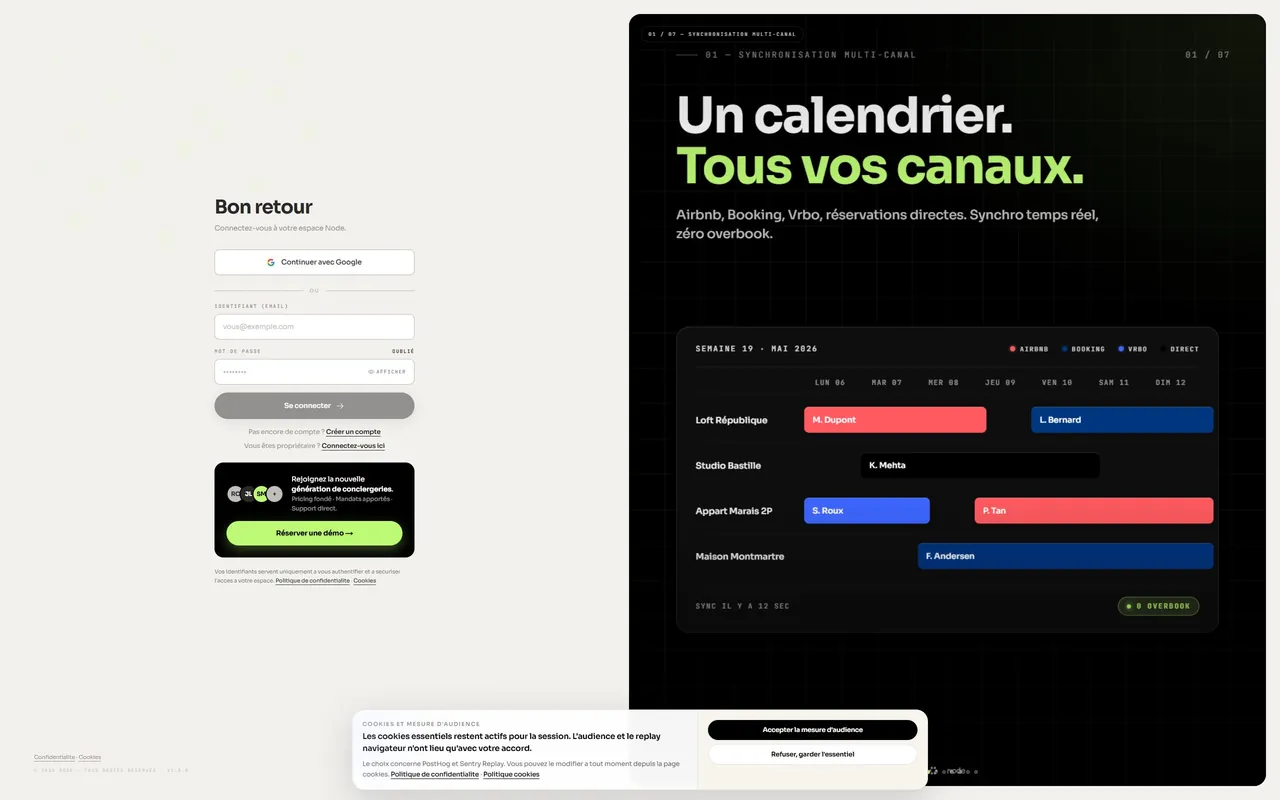
« Kaishift built the interface of Node, our channel manager: dense but readable, made to be used every day. A responsive team that quickly understands the business. »
« Kaishift built the interface of Node, our channel manager: dense but readable, made to be used every day. A responsive team that quickly understands the business. »
« Kaishift built the interface of Node, our channel manager: dense but readable, made to be used every day. A responsive team that quickly understands the business. »
Translated from French. Each quote was approved in writing by the client.
Questions
Common questions
What is digital transformation consulting?
Digital transformation consulting is advice on how a company should change its processes and systems, usually delivered as an assessment, a target state and a roadmap. For an SME, the risk is ending up with a document and no software. Kaishift runs a short version of the assessment, counting where the hours go, and then builds the first fix itself.
How long does digital transformation take for a small business?
It never really ends, but the first result should not take long. In our usual shape, the first process is mapped in week one and live on your accounts within the first month. Days 30 to 90 cover the next two processes. At day 90 you get a written review and decide whether to continue, and everything built so far stays yours.
Do we have to replace the tools we already use?
Usually not. Most SMEs already pay for a CRM, an accounting tool, a booking platform and a messaging app. The first job is connecting them so a record is typed once. We replace a tool only when the map shows it is the bottleneck, and we do not resell software, so we gain nothing from moving you off what works.
What does a digital transformation project cost?
There is no price list. Cost depends on how many processes are in scope, how many systems each one touches, whether a step needs AI, and how much custom software is needed compared with connecting what you already have. After a 30-minute call, you receive a written proposal within 72 hours, with a free demo on one of your real tasks.
Do we need AI to transform the business?
Not for most of it. Most recurring processes are rules: when this arrives, do that. Rules are cheaper to run and easier to check. AI earns its place on the step where someone reads something messy and makes a call, such as sorting incoming emails or reading a scanned invoice. We add it there, and log each decision it makes.
What happens if we stop working with Kaishift?
Nothing breaks. The code is in your repositories, the systems run on your cloud accounts and the API keys are in your company's name. Each process ships with written documentation, so your team or another provider can take it over. Stopping after the 90-day review is a normal outcome, not a failure.
Another question? Write to us, we answer the same day.
What does a digital transformation agency do for a small business?
It replaces manual work with software, one process at a time, and proves each change with numbers. In digital transformation for small business, that cycle has four parts.
Map where the time goes. We list the processes that repeat every week, then count: how often each runs, how many minutes it takes, how many people and tools it passes through, and how often it goes wrong. This takes days, not months. It usually turns up one process that eats more hours than anyone guessed, and one step nobody needs anymore.
Fix one process end to end. Not the first half of five processes. One, from the moment it starts (a lead arrives, a booking lands, an invoice falls due) to the moment it is done, with the error cases handled and an alert going to a channel your team reads.
Measure it. The same counts as the map, now taken from the system's own logs instead of estimates.
Pick the next one. Chosen by the numbers from the map, not by whoever complained last.
The software itself comes from our other services: workflow automation when the process can be written as rules, a custom CRM when the sales pipeline lives in spreadsheets, and custom software when no off-the-shelf tool fits the way you work.
What is digital transformation consulting, and how is this different?
Digital transformation consulting is advice on how a company should change its processes and systems, usually delivered as an assessment, a target state and a roadmap. Plenty of it is serious work. The trouble for an SME is that the deliverable is a document, and a document does not answer a single customer faster.
We do the assessment too, but short, and it ends in a build.
Large consultancy programme
Kaishift
Starts with
An assessment and a strategy deck
A count of where the hours go, then one process
First thing your team uses
After the roadmap is approved and an integrator is hired
Working software, in weeks
Scope
The whole organisation, several workstreams in parallel
One process at a time, the next one chosen by the numbers
Who builds
Often a separate implementation partner
The same engineers who drew the map
Who holds the accounts
Depends on the contract
You, from the first day
When a large consultancy is the right call. If you are merging two companies, replacing an ERP across several subsidiaries, reorganising hundreds of people, or your board needs an independent assessment it can defend to investors or a regulator, hire one. That work is mostly about decisions and people, and a large firm brings the partners and the change-management bench for it. We do not. If you bring us that problem, we will say so on the first call.
What happens in the first 30 and 90 days?
A short loop, repeated. This is the usual shape, adjusted on the call to your size and to what the map shows.
Day 0. A 30-minute call. You describe what costs you time. Within 72 hours you receive a written proposal and a free demo running on one of your real tasks. No commitment.
Week 1. Access is collected in one pass and the map is drawn: the recurring processes, each with runs per week, minutes per run, handoffs and error rate.
Weeks 2 to 4. The first process is fixed end to end and goes live on your accounts. Your team uses it on real work, and we fix what real work breaks.
Day 30. First measurement against the map. You see what changed, in your own numbers, and decide whether to continue.
Days 30 to 90. The second and third processes, picked from the map. This is usually where AI enters, on the one step that needs a message read or a document understood.
Day 90. A written review: what runs, what it changed, what your team now owns, and what we would fix next. Stopping here is a normal outcome, and you keep everything.
Where do SMEs usually start?
With the process that repeats most and passes through the most hands, which is rarely the one on the strategy slide. These are typical first projects by department, with work we have shipped where we have it.
Department
Typical first project
From our projects
Sales
Every lead from forms, ads and WhatsApp lands in one CRM with its follow-up scheduled
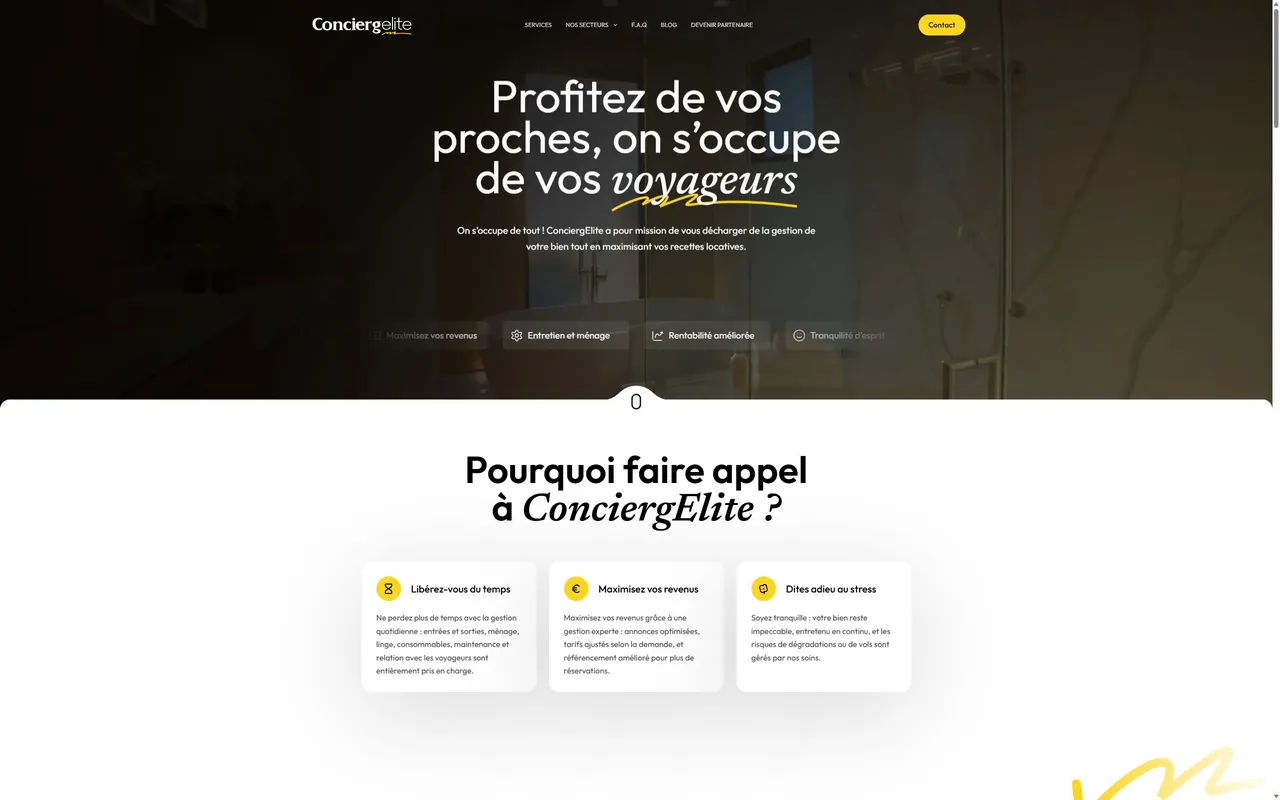
For ConciergElite and Hostlux, one holding, the work was mostly automation and AI agents: CRMs, a sales AI that simulates sales conversations, blog automation
Operations
Bookings, schedules, teams and incidents in one place instead of five tools
Hostguide: a platform for short-term rental managers covering listings, bookings, calendar sync, cleaning planning, incident tracking and reports
Finance
Invoices generated from the booking or the job, reminders sent without anyone having to remember
Hostguide's platform includes reports and invoicing. Beyond that we have no finance case to name yet, and we will not invent one
Customer service
Customers get prices and a way to book in one message, in their own language
Lavage Askjour, a hand car wash in Marrakech: public prices and about 20 pre-filled WhatsApp messages. Balade Agadir: a site in French, Arabic and English where every ride books in one WhatsApp message
Two of those are small local businesses, and that is deliberate. At their size, transformation is a customer getting an answer in one message instead of a phone call nobody picks up. Customer-facing pieces like these come from our web design work.
Where does AI fit in a transformation?
On the steps where a person currently reads something messy and makes a call: an email that might be an order, a WhatsApp voice note asking about availability, a scanned invoice, a complaint that needs routing. That is where AI agents earn their cost. Everywhere else, a rule is cheaper and easier to audit.
Our decision rule for AI and digital transformation consulting is blunt: if you can write the rule down, do not pay a model to guess it. Most processes we map are mostly rules with one judgment step in the middle. We build the rules as a workflow, hand that one step to an agent, and log every decision it makes so a person can check it.
How do you measure whether it worked?
With three numbers taken before and after, from your own operations: hours returned, errors avoided, response times. Hours returned is runs per week multiplied by minutes saved per run. Errors avoided is the count of mistakes the old process produced (wrong prices, double bookings, missed follow-ups) against what the new one produces. Response time is the gap between a customer asking and getting a useful answer.
We will not quote you an average saving from other clients. Your baseline comes from the map in week one and the after-figures come from the system's logs, so you can check the comparison yourself. If a process does not move those numbers, we say so at the 30-day review, and it does not get a second phase.
Who owns what we build?
Your company does, and your team runs it. The code sits in your repositories, the systems run in your cloud accounts, and the API keys carry your company's name. What we self-host carries no licence fee: Supabase is open source, and n8n is free for internal business use under its own licence, and pay-per-use services bill your account directly. Every process ships with written documentation, and the people who use it are shown how it works and how to change the simple parts. The reasoning is in own your automation stack. If a transformation only holds while the agency is still being paid, what you bought is a dependency.
Who is this not for?
Good fit
Poor fit
A company of a few people to a few hundred, with processes that repeat every week
A group that needs a multi-year programme across subsidiaries
You know which work hurts, even if you cannot yet say how much
You need a strategy document for a board, not software
Someone on your side will own each process once it runs
Nobody internal will own it after launch
You want to see one thing working before committing to the next
You want everything changed at once, on a fixed date
One more refusal: we do not automate a process nobody has agreed on. If sales and operations disagree about how an order should flow, software will only make the disagreement faster. That decision is yours to make first, and we will tell you when we see one waiting.
How does it start?
With one process. Kaishift is a team of 12+ forward-deployed engineers led by our CTO, Amine Lamfichekh, working from Morocco with companies in Europe, Morocco, the Arab world and North America, in French, Arabic, English and Spanish. Bring the process that costs you the most time to a 30-minute call. Within 72 hours you have a written proposal and a free demo on one of your real tasks, and you decide from there.
dev · AI · SaaS · CRM · an AI agent for every role · custom software · web design · nearshore · dev · AI · SaaS · CRM · an AI agent for every role · custom software · web design · nearshore · dev · AI · SaaS · CRM · an AI agent for every role · custom software · web design · nearshore · dev · AI · SaaS · CRM · an AI agent for every role · custom software · web design · nearshore · dev · AI · SaaS · CRM · an AI agent for every role · custom software · web design · nearshore · dev · AI · SaaS · CRM · an AI agent for every role · custom software · web design · nearshore ·