A SaaS development agency that takes your product from MVP to v1, on accounts you own
We turn your idea or your internal tool into a product other companies pay for: sign-in, roles, billing, an admin back office. Built on your cloud, in your name.
Kaishift is a SaaS development agency for founders and SMEs who need a product that customers can find, pay for and use without ever calling you. Some arrive with an internal tool that other companies keep asking to borrow. Others have a waiting list and need to build a SaaS MVP before the interest cools. We take both from MVP to v1, with the unglamorous parts a product needs before strangers pay for it. Everything runs on your repository, your cloud and your accounts from the first commit.
SaaS development is building one hosted product that many customer companies use at the same time, each seeing only its own data. Beyond the features, it covers tenant separation, sign-in and roles, subscriptions and invoices, an admin back office and onboarding. The test is simple: every decision must still hold at customer fifty, not only at customer one.
SaaS development
what it does for you
A v1 that can sell
Accounts, payments and onboarding done properly, so the first customers can pay without calling you.
Each customer sees only its data
Tenant separation decided before the first line of code, not patched in later.
Yours from the first commit
Your repository, your cloud, your keys. You can take it in-house any day.
Your case is different?
Tell us in 30 minutes. Within 72 hours you get a written proposal and a free demo on your case.
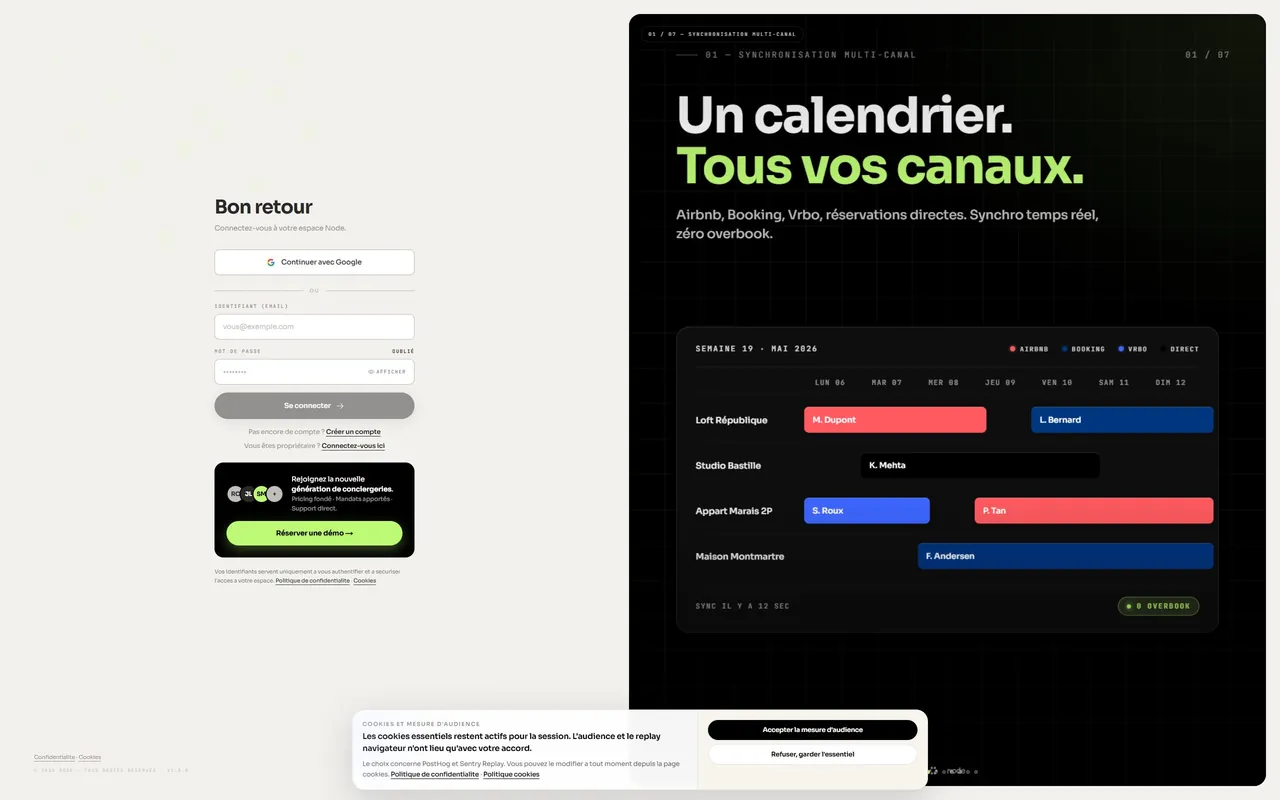
« Kaishift built the interface of Node, our channel manager: dense but readable, made to be used every day. A responsive team that quickly understands the business. »
Translated from French. Each quote was approved in writing by the client.
Questions
Common questions
How long does it take to build a SaaS MVP?
It depends on the v1 list more than anything else. One core workflow with managed auth and invoice billing is a far smaller build than seats, usage pricing and five integrations. The written proposal you receive within 72 hours of the call states the timeline for your scope, and you click through working software early in the build, not at the end.
Should our SaaS be single-tenant or multi-tenant?
Multi-tenant by default: one shared database, a tenant key on every row, and row-level security so the database itself blocks cross-customer reads. It is cheaper to run and to update. We switch to a database per customer when contracts require physical separation or each client needs its data in a specific country. That choice is made before the first line of code.
Can you turn our internal tool into a SaaS without rewriting it?
Often, yes. If the data model can take a tenant key cleanly, we keep the business logic and rebuild the product layer around it: sign-up, roles, billing, admin and onboarding. If customer data is spread across spreadsheets and scripts, a clean rebuild usually costs less than patching. We read the code first and say which case you are in, in writing.
Who owns the code and the payment account?
Your company does, from the first commit. The repository, cloud project, database, domain and the payment provider account that receives payouts are all registered in your name, and we work inside them as invited users. Self-hosted parts stay open source. If you stop working with us, the product keeps running and nothing has to be transferred.
Can the product work in French, Arabic and English?
Yes. The team works in French, Arabic, English and Spanish, and builds right-to-left Arabic layouts properly rather than mirroring them at the end. Languages are planned into the data model from the start: translated content, per-customer language settings, emails and invoices in the customer's language. Adding a language after launch is possible, but it costs more than planning for it.
Another question? Write to us, we answer the same day.
What does a SaaS development agency actually build?
A SaaS development agency builds the parts customers never praise but notice the minute they break. Features are why someone signs up. The rest is why they stay:
Multi-tenant data. Every row knows which customer it belongs to, and the database itself refuses to show it to anyone else.
Auth and roles. Sign-up, login, password reset, invitations, and roles such as owner, member and read-only, enforced on the server rather than hidden in the interface.
Billing. Plans, trials, invoices, failed payments, and a written rule for what happens to an account that stops paying.
Admin back office. Your team's view of every account (who signed up, who is stuck, who pays) and the switches to extend a trial or fix a record.
Onboarding. The shortest path from sign-up to the first useful result.
Analytics. Events on the few actions that predict whether an account stays.
AI features, only where they do a job a user would otherwise do by hand.
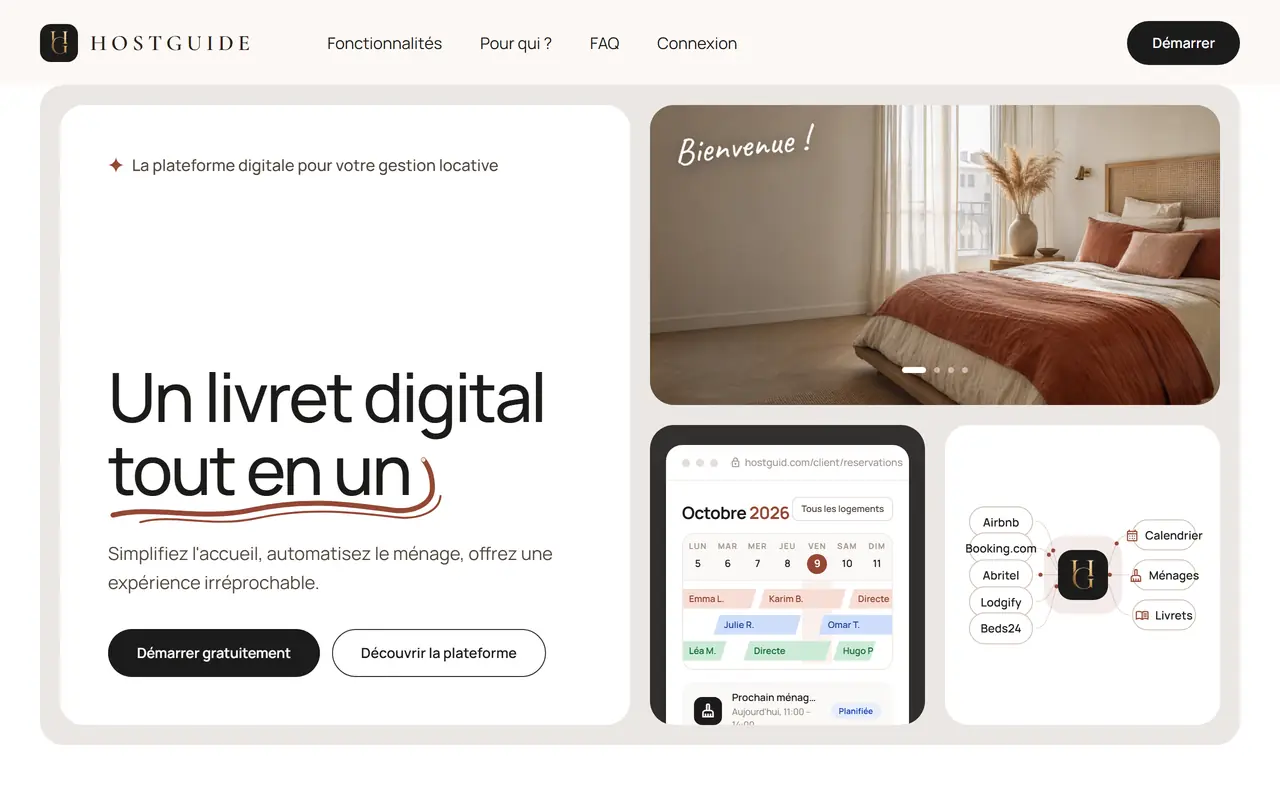
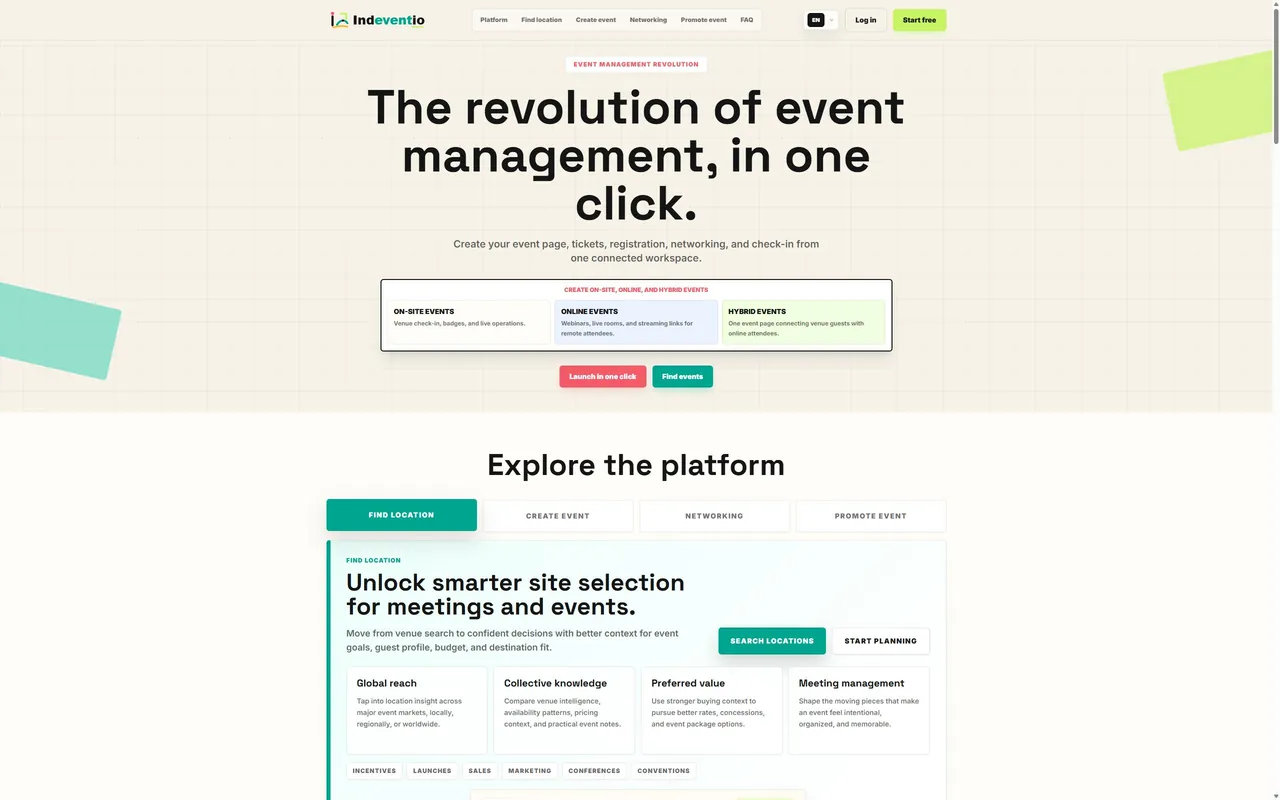
For Hostguide, a platform for short-term rental managers and concierges, we built the product and its site: listings, bookings, digital welcome books, cleaning teams, incidents and reports, behind its own sign-up and login. Its onboarding starts where managers already are, with calendar sync from Airbnb, Booking.com and the other tools they use. For Node, a channel manager for hotels and rental managers, we built a dense but readable interface for people who keep it open all day. For Indeventio, we built a marketplace product with search, venue pages and booking requests.
What changes when an internal tool becomes a product?
Every shortcut an internal tool gets away with breaks: one company, trusted users, an administrator down the corridor. A product can assume none of them:
Inside your company
Once outside customers sign up
One company, so no customer ID on the data
Every table carries a tenant key, and every query filters on it
Settings per customer, with defaults that work untouched
Nobody pays
Plans, limits, invoices, and a rule for unpaid accounts
Bugs reported in the corridor
Logs, an audit trail, and a way to see what a customer sees
The failure we design against first is the leak: customer B opens a page and sees customer A's records because one query forgot its filter. That is why tenant separation goes in before the first feature, enforced by the database itself (row-level security in Postgres) and not only by application code. Adding it after launch means re-reading every query ever written.
What goes in v1, and what waits?
V1 holds what a paying customer needs to get value without you on the phone. Everything else waits until customers ask for it, more than once.
In v1:
Tenant separation and backups, because neither can be added safely later.
Sign-up, login, invitations and two or three roles.
One billing path that matches how your first customers already pay.
An admin back office, including a way to see an account the way its user sees it.
Onboarding to the first useful result, with events on the actions that matter.
One core workflow, done properly.
Waits for later:
Single sign-on (SAML) and enterprise permission matrices, until a buyer writes them into a contract.
A public API, until a customer has a concrete integration to build.
Native mobile apps, while a responsive web app covers the use.
Usage-based pricing with metering, unless usage is the product.
A custom report builder. Ship the three reports people asked for.
Billing is the easiest place to over-build. If your first customers sign annual contracts after a call, v1 billing can be an invoice and a switch in the admin. Indatex puts a "Request Premium Access" form next to its login: access follows a conversation, not a card form. In markets where business customers pay by bank transfer, a payment-proof upload that an admin approves beats a card checkout nobody uses, and the live Indeventio platform handles its promotions that way. Self-serve card billing earns its place once customers arrive faster than you can talk to them.
Which build decisions should you settle before writing code?
Six decisions shape the cost of everything after them. Our defaults, and when we switch:
Decision
Our default
When we go the other way
Single or multi tenant
One shared database, a tenant key on every row, row-level security
A database per customer when contracts require physical separation or per-client data residency
Auth: build or buy
Managed auth (Supabase Auth or similar) in your account
Custom only for an identity rule no provider can express
Billing: build or buy
Stripe, or the provider your market supports, for cards, subscriptions and invoices
Manual invoices and admin switches while sales close by contract
Admin back office
Purpose-built screens for the handful of things your team does daily
A generic database admin tool for internal, low-risk edits only
Analytics
A product analytics tool plus your own events table
The events table alone while accounts number in the dozens
Hosting
A managed platform on your account
Self-hosted open source on your server when cost or residency calls for it
The rule behind the table: buy what is identical in every SaaS (login, card payments), build what is your product. Nobody picks your software for its password-reset email.
Where do AI features earn their place?
AI earns a place where it removes a task the user would otherwise do by hand, and where a mistake is cheap to spot. Drafting a guest reply, sorting an incoming request, summarising a long record: yes. Setting a price or moving money without a human check: not in v1. Node describes the agent in its own product as a copilot that does the work while the manager validates. That shape, machine proposes and person approves, is the default we build to.
Two things are set up from day one. Model calls go through API keys in your name, billed to you at cost. And AI usage is counted per customer account, because a flat plan with unlimited model calls can turn your heaviest customer into your least profitable one. If the AI is the product rather than a feature, start with our AI agents work.
How does a SaaS build run with Kaishift?
A 30-minute call. You describe the product, the first customers and how they pay today. Amine Lamfichekh, our CTO, scopes it.
Proposal and demo within 72 hours. A written proposal and a free demo on one of your real tasks.
Scope on paper. The v1 list and the "later" list, agreed before the build starts.
Accounts in your name. Repository, cloud, domain, payment provider, email sender. We are invited in; you are never a guest in your own product.
Data model and tenant separation first. Schema, roles and access rules before any screen.
The core workflow. The one job customers pay for, usable end to end.
Billing, admin and onboarding. Tested with fake accounts that try to read each other's data.
Pilot with real customers. A few accounts use it for real work; the admin and the events show where they get stuck.
V1 launch, then cycles. Each cycle is shipped, documented and deployed on your accounts. You can stop at any cycle and keep everything.
Who owns the code, the cloud and the accounts?
You do, from the first commit. The repository, the cloud project, the database, the payment account that receives payouts and the domain are all registered to your company. Anything we self-host for you keeps public source code and no licence fee. Choosing a SaaS product development agency is partly choosing who holds those accounts. An investor or a buyer will ask, and "the agency has them" is the wrong answer.
What drives the cost of custom SaaS development?
Scope, not hours. Every Kaishift price is set after the consultation, and what moves it is knowable early:
How many roles there are, and how different their permissions are.
Billing shape: one plan paid by invoice, or tiers, trials, seats and usage.
Integrations with outside systems, and whether those systems have usable APIs.
Languages, especially Arabic with right-to-left layouts planned into the data model.
You have early customers, a waiting list, or an internal tool other companies ask to use
You want an idea tested before anyone has shown interest
You want code, cloud and payment accounts in your company's name
You want an agency to host and run the product for you indefinitely
You accept a v1 that does one workflow well
You need the whole roadmap built before the first customer logs in
You plan to keep improving the product after launch
You need a fixed price against a long specification written up front
If the right-hand column sounds like you, say so on the call. We will tell you plainly.
Talk to the person who scopes it
Thirty minutes with Amine Lamfichekh. Bring the internal tool, the spreadsheet, or the list of people who said they would pay. Within 72 hours you get a written proposal and a free demo running on one of your real tasks, no commitment. The team works from Morocco in French, Arabic, English and Spanish, for clients in Europe, the Arab world and North America. Book the call.
dev · AI · SaaS · CRM · an AI agent for every role · custom software · web design · nearshore · dev · AI · SaaS · CRM · an AI agent for every role · custom software · web design · nearshore · dev · AI · SaaS · CRM · an AI agent for every role · custom software · web design · nearshore · dev · AI · SaaS · CRM · an AI agent for every role · custom software · web design · nearshore · dev · AI · SaaS · CRM · an AI agent for every role · custom software · web design · nearshore · dev · AI · SaaS · CRM · an AI agent for every role · custom software · web design · nearshore ·